


【Survey Summary】
①34.6% want to "actively use" generative AI in romantic situations
34.6% of respondents said they would like to "actively use" generative AI in matters related to romance. By gender, the figure was higher among women (38.4%) than men (30.8%).
② Acceptance of generative AI use: 43.4% for "advice on approaching someone" versus 23.4% for "composing confession lines"
Items such as "advice on approaching someone of interest" (43.4%) and "choosing an anniversary gift" (42.2%) exceeded 40%, while "composing lines for confessing one's feelings" stood at 23.4% and "AI-generated dating app/social media profile icons" at 21.4%.
③ Most common reason for not wanting to use it: "I want to express things in my own words" (36.7%)
Among those who said they do not want to actively use generative AI for matters related to romance, the most common reason, at 36.7%, was "I want to express things in my own words."
④ Reluctance toward "using it myself" versus "my partner using it" differs by gender
Comparing the gap between "I have no reluctance about using it myself" and "I have no reluctance about my partner using it" across items by gender, women's comfort with using it themselves was 2.2 points higher, while men's comfort with their partner using it was 2.1 points higher.
【Survey Overview】
・Survey theme : Survey on "Gen Z's AI and Romance"
・Survey period : September 3–4, 2026
・Conducted by : "Gen Z Trend Lab byGMO" (GMO NIKKO, Inc.)
・Survey area : Japan
・Survey subjects: 500 Gen Z (ages 16–28) high school students, university students, and working adults (250 men, 250 women / High school students: 89 men, 100 women / University students: 73 men, 63 women / Working adults: 88 men, 87 women)
・Methodology : Internet survey
※Percentages are rounded to the nearest first decimal place, so totals may not equal 100.0%.
【Detailed Survey Results】
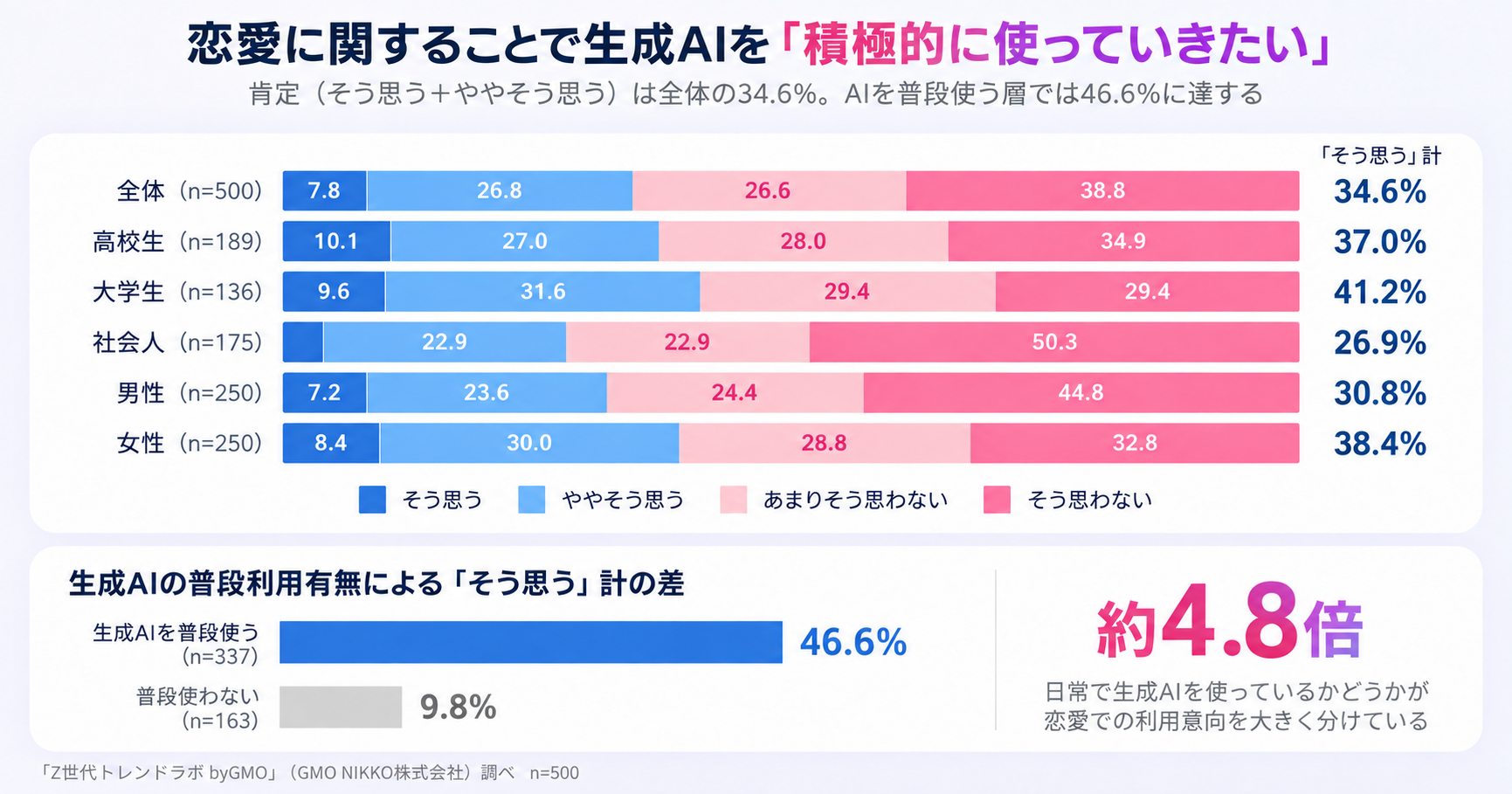
■34.6% want to "actively use" generative AI in romantic situations
Asked whether they would like to actively use generative AI in matters related to romance, 34.6% of respondents gave a positive response, combining "I think so" and "I somewhat think so." By category, the figure was 41.2% for university students, 37.0% for high school students, and 26.9% for working adults. By gender, women (38.4%) showed a slightly more positive attitude toward using generative AI in romance than men (30.8%).
Meanwhile, by current generative AI usage status, the positive response rate was 46.6% among those who regularly use generative AI, compared with 9.8% among those who do not—a difference of approximately 4.8 times.
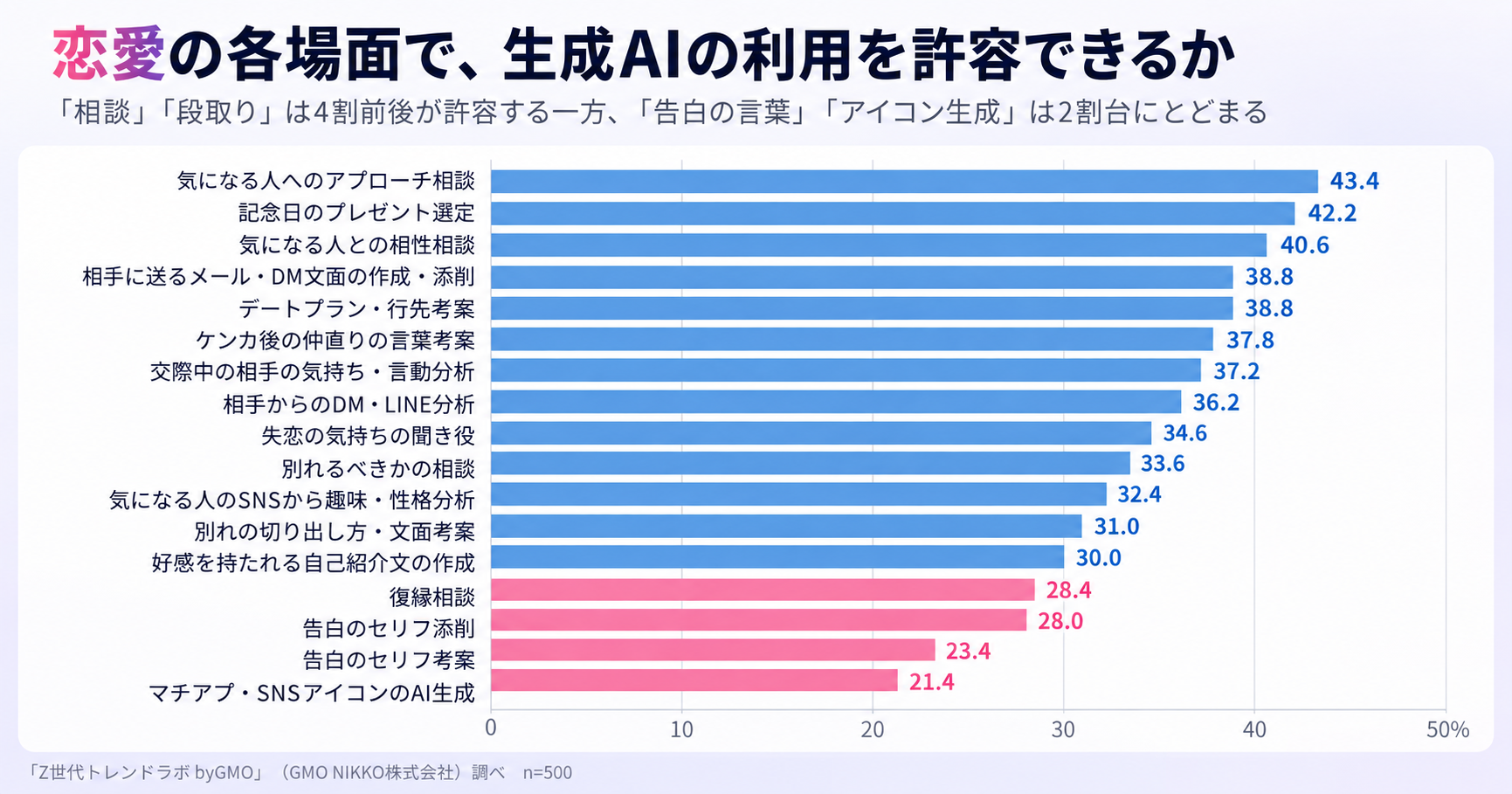
■Among 17 romantic scenarios, "acceptable" use of generative AI is highest for "advice on approaching someone" (43.4%) and lowest for "composing confession lines" (23.4%)
All respondents were asked whether they found the use of generative AI "acceptable" in 17 romantic scenarios. The highest was "advice on approaching someone of interest (how to start a conversation, create an opportunity, etc.)" at 43.4%, followed by "choosing an anniversary gift" (42.2%) and "advice on compatibility with someone of interest" (40.6%). Generative AI use tended to be relatively more accepted in scenarios involving romance-related consultation and preliminary research. On the other hand, "editing/proofreading confession lines" stood at 28.0%, "composing confession lines" at 23.4%, and "AI-generated dating app/social media profile icons" at 21.4%. Acceptance of generative AI use was relatively lower in scenarios involving conveying one's own feelings or expressing oneself.
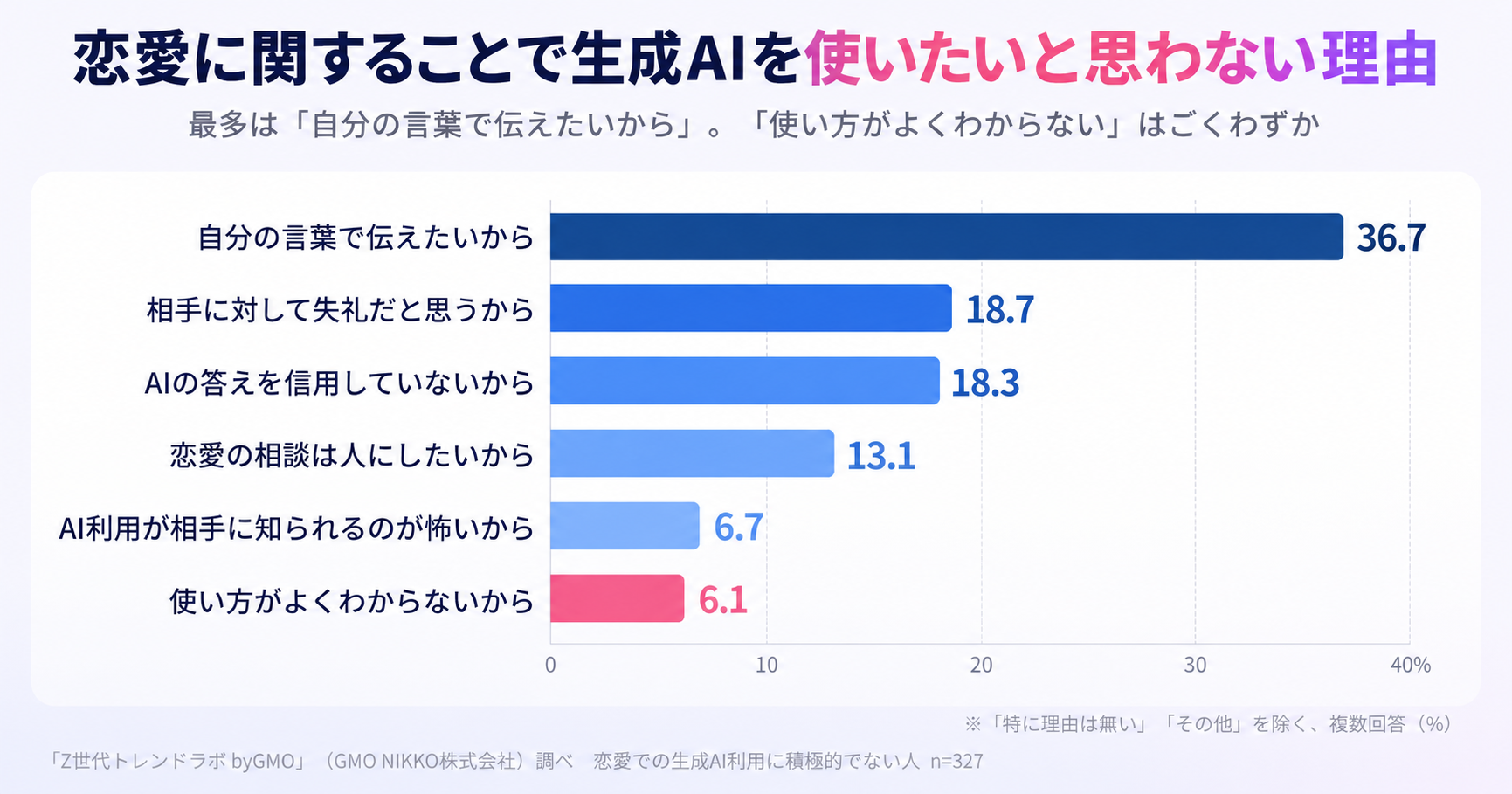
■ Most common reason for "not wanting to use it": "I want to express things in my own words" (36.7%)
Among the 327 respondents who said they do not want to actively use generative AI for matters related to romance, the most common reason (multiple answers allowed) was "I want to express things in my own words" at 36.7%, followed by "I think it would be rude to my partner" (18.7%) and "I don't trust AI's answers" (18.3%). Meanwhile, "I don't really understand how to use it" was only 6.1%. Rather than concerns about AI's capabilities or how to use it, reasons related to communication in romance—such as "wanting to express things in my own words" and "it would be rude to my partner"—ranked highest.
■ Reluctance toward "using it myself" versus "my partner using it" differs by gender
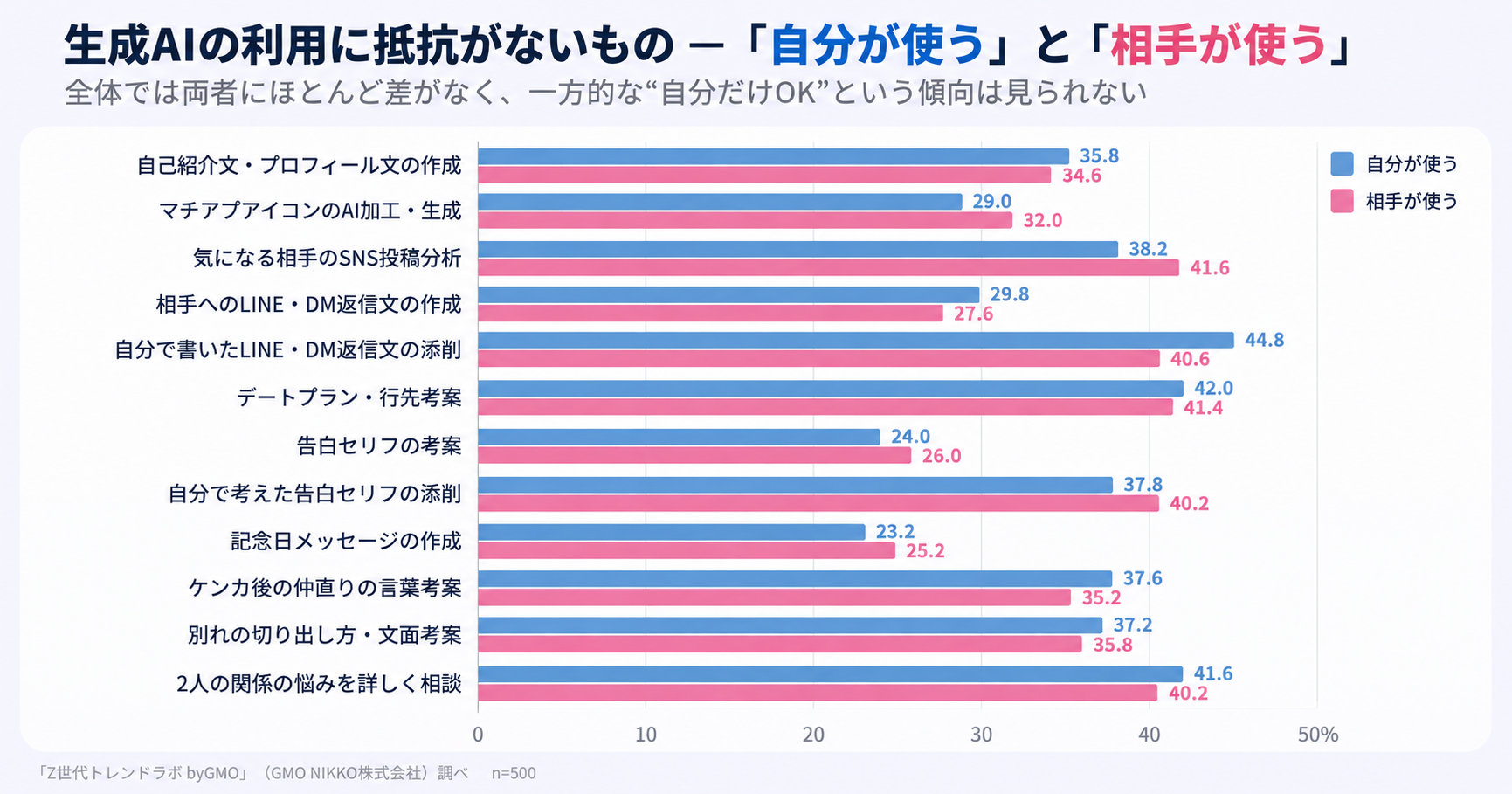
Respondents were asked whether they had "no reluctance" about "using generative AI myself" and about "my dating partner using generative AI" across 12 romance-related scenarios where generative AI use is conceivable.
Overall, the difference between the two ranged from -3.4 to +4.2 points, with no clear overall tendency toward less reluctance for either.
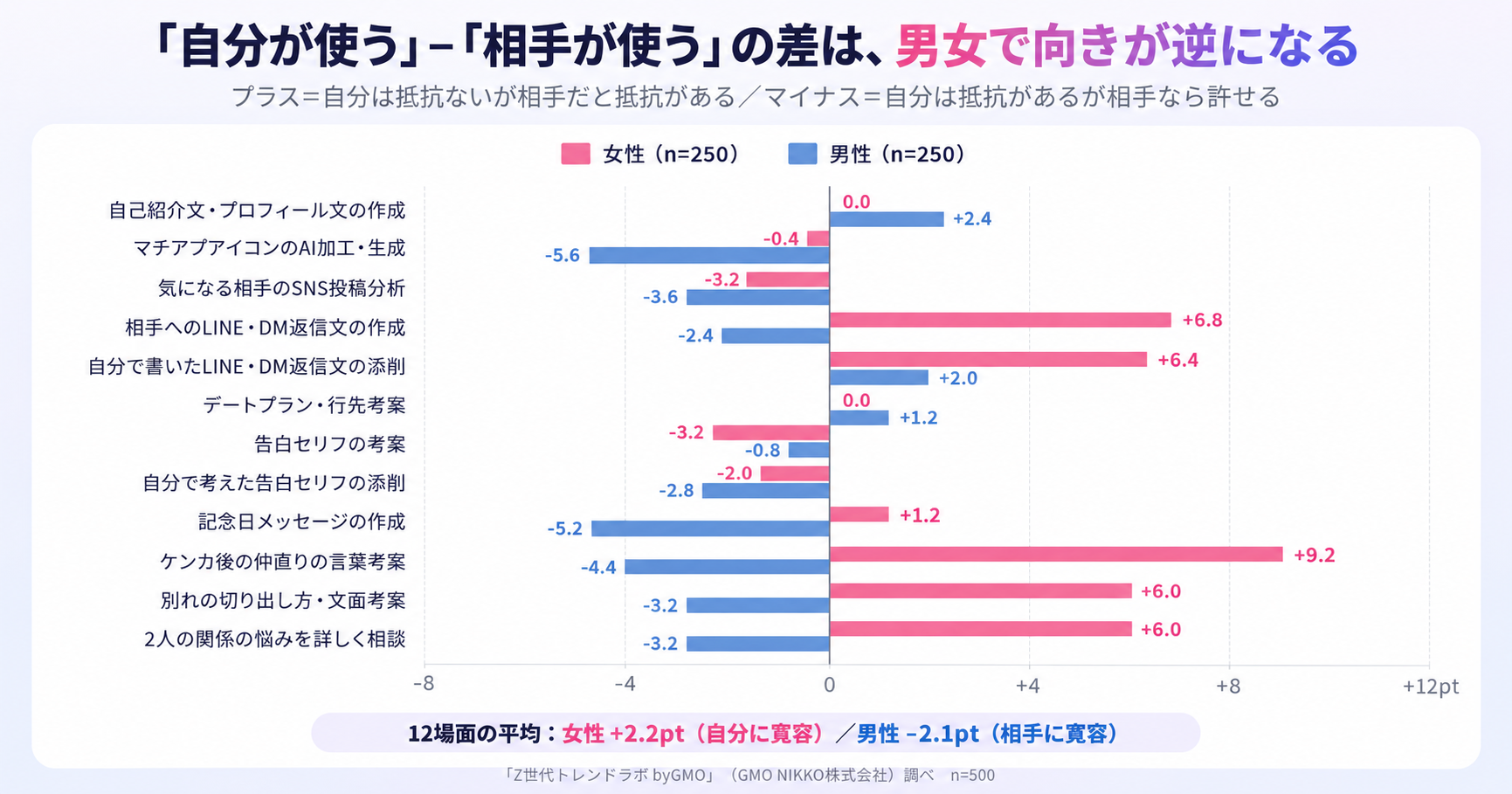
However, looking at the average across the 12 scenarios by gender, opposite tendencies emerged between men and women.
・Women: Comfort with "using it myself" was 2.2 points higher → more likely to feel reluctance about their partner's use
・Men : Comfort with "my partner using it" was 2.1 points higher → more hesitant about using it themselves
Among women, the largest gap was for "composing reconciliation messages after an argument," at 37.2% for using it themselves versus 28.0% for their partner using it—a 9.2-point difference. Among men, the largest gap was for "AI editing/generation of dating app icons," at 34.0% for using it themselves versus 39.6% for their partner using it, 5.6 points higher for partner use.
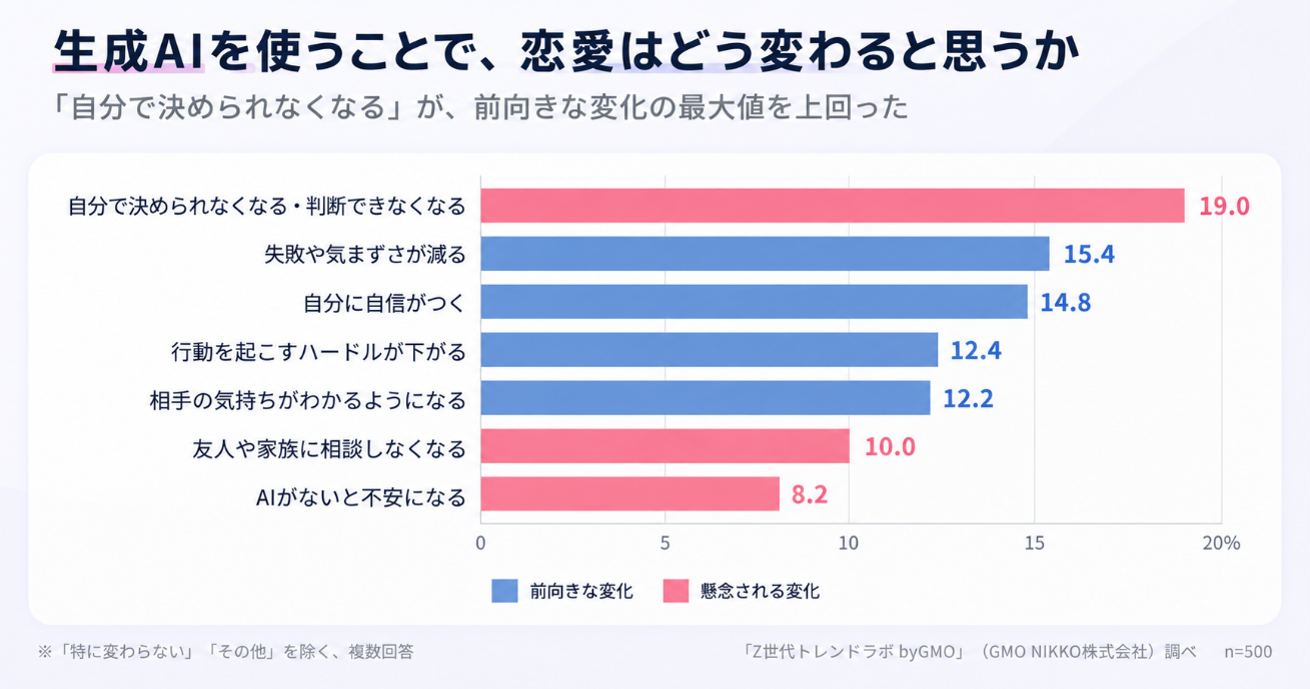
■ How will generative AI change romance? "I'll no longer be able to decide for myself" (19.0%)
All respondents were asked how they thought romance would change as a result of generative AI use (multiple answers allowed). The most common response was "I will no longer be able to decide or judge things for myself" at 19.0%, which exceeded the highest-ranked positive change, "fewer failures and awkward moments" at 15.4%.
■Survey Comment: Hiroyuki Kozu, Chief Researcher, "Gen Z Trend Lab byGMO"
What this survey reveals is a clear line that Gen Z draws between romance and generative AI. In "preparatory" scenarios such as consultation, date planning, and gift selection, around 40% accept the use of generative AI. However, in scenarios that call for being authentically oneself—such as generating a profile icon or composing confession lines—acceptance drops to the 20% range. This suggests that AI is accepted as an "advisor to help one navigate romance successfully," but is less readily accepted as a "stand-in for oneself."
Another interesting finding is the difference in reluctance between "when I use it" and "when my partner uses it." Women tend to feel more reluctance about their partner using AI to compose message text than about using it themselves, while men tend to be more tolerant of their partner's use and show more hesitation about using it themselves. Even though both are described as "reluctance," the nature of that reluctance differs between men and women.
It is also worth noting that the most common reason for not wanting to use it was "I want to express things in my own words," while "I don't understand how to use it" was minimal. This suggests that the barrier in this area is not simply about functionality or literacy, but that values around romance itself are also linked to attitudes toward AI use. Furthermore, given that there is roughly a 4.8-fold difference in willingness to use AI depending on whether someone regularly uses generative AI, perceptions of AI in the romance domain may continue to shift as everyday AI use becomes more widespread. When companies design communication in this space, a message framed as "use AI to prepare, but convey it in your own words in the end" is likely to be better received than one suggesting "AI will handle romance on your behalf."
【Regarding the Provision of Survey Results】
Additional survey results and detailed data beyond the items above are also available. This survey can be used by companies for product and service development, communication design, and media planning based on an understanding of Gen Z's needs.
Media representatives who wish to receive this information are welcome to contact "Gen Z Trend Lab byGMO"(E-mail:[email protected]). Please note that this information is provided exclusively to media representatives.
【About "Gen Z Trend Lab byGMO"】
"Gen Z Trend Lab byGMO" is a marketing service that helps companies resolve communication challenges by gaining deep insight into the true feelings, emotions, and values hidden within Gen Z. Leveraging our proprietary Gen Z influencer member organization and one of Japan's largest research panels(※2), we provide multifaceted support for marketing activities specialized in the younger generation.
■Trend surveys and interview articles by "Gen Z Trend Lab byGMO"
(URL:https://www.koukoku.jp/truemarketing/genzlab/)
(※2)Survey monitors are linked with the "JAPAN Cloud Panel," comprising 39.34 million people in Japan (as of April 2026), provided by GMO Research & AI, Inc., which operates the internet research business within the GMO Internet Group.
【About GMO NIKKO】(URL:https://www.koukoku.jp/)
The advent of generative AI has fundamentally transformed the premises underlying search, shopping, and work itself. At the forefront of this change, GMO NIKKO is evolving from an "advertising agency" into an "AI marketing support company." Since the emergence of generative AI, we have been among the first to research how "information engagement through AI," including AI search, is evolving, and have refined this knowledge into cutting-edge solutions and consulting. Even as intelligence continues to evolve toward AGI and ASI, we will work together with our customers to create a future in which their businesses continue to be chosen by AI and AI agents, and continue to grow. Effective October 1, 2026, GMO NIKKO became a group company of GMO Commerce, Inc. (President & CEO: Masato Yamana; hereinafter "GMO Commerce"), transitioning to a marketing business structure centered on GMO Commerce.
■For more details
https://internet.gmo/news/article/234/
 AI Summary
34.6% of Gen Z respondents said they would like to actively use generative AI in romance.
Acceptance varies by scenario: 43.4% for advice on approaching someone, versus 23.4% for drafting confession lines.
