


(※1)EOL (End of Life): the discontinuation of a software, license, or product offering. EOS (End of Support / End of Sale): the discontinuation of support.
【Background to the Service Launch】
Japan’s core corporate systems are now at a major turning point. According to the “Summary Report of the Legacy System Modernization Committee” (※2)released by Japan’s Ministry of Economy, Trade and Industry (METI) in May 2025, legacy systems remain in place at 61% of companies across all industries, and at 74% of large enterprises. In the mainframe-based core systems that have long supported corporate operations, aging hardware, the end of parts procurement and OS support, and a shrinking pool of skilled engineers are occurring at the same time—making the very act of maintaining and operating these systems a growing risk.
In addition, systems built on outdated language and framework versions(※3)are also increasingly exposed to expanding security risks tied to end of support (EOL/EOS). Rather than rebuilding existing systems from scratch, migrating to a new environment while making the most of current assets is drawing attention as an option for pursuing modernization while containing cost and risk.
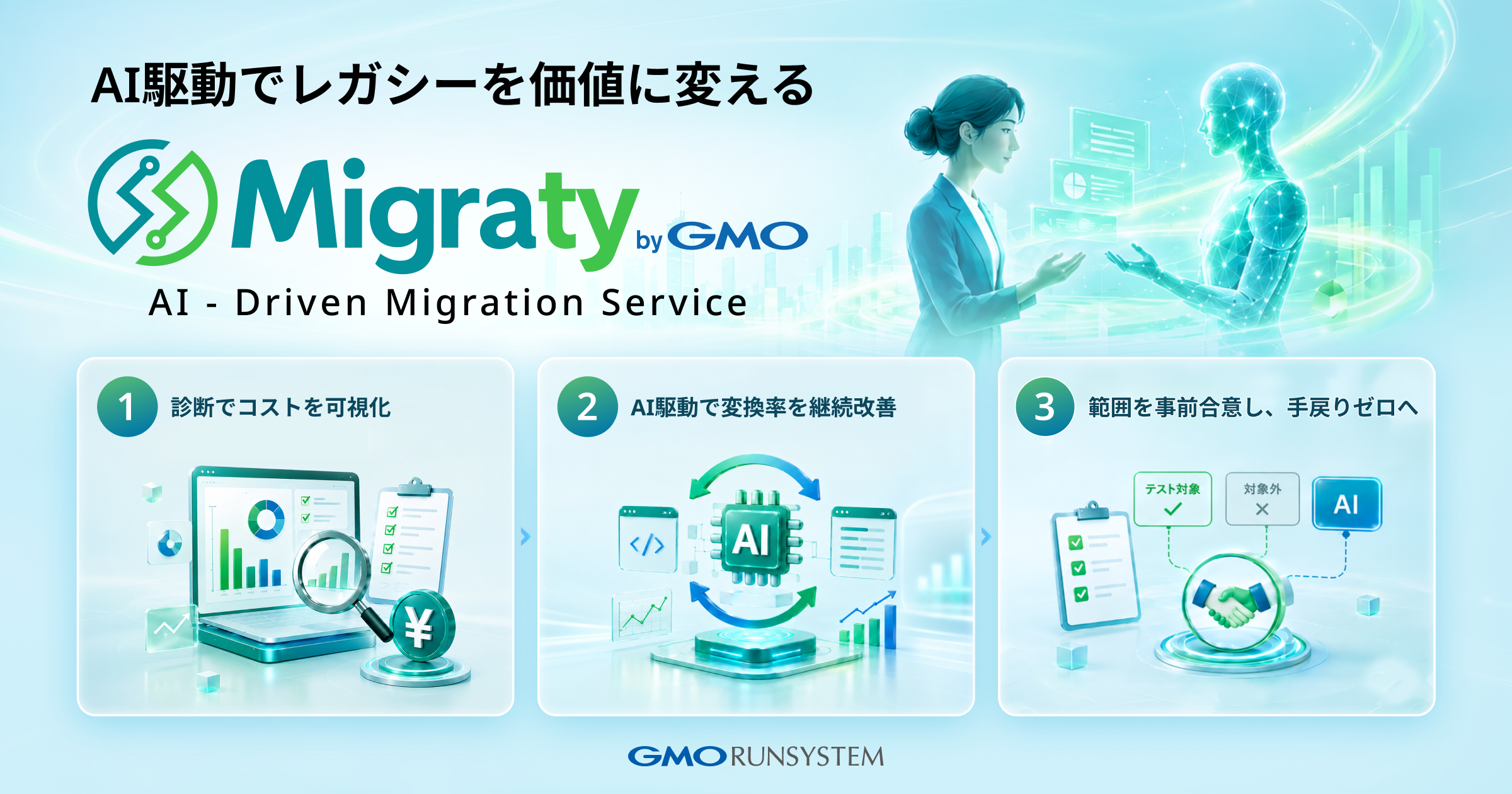
Against this backdrop, GMO RunSystem is offering “Migraty byGMO,” which combines AI-driven automatic analysis, conversion, and test generation with quality assurance by expert engineers. By providing comprehensive, one-stop support—from mainframe modernization to EOL/EOS compliance for systems built on outdated languages and frameworks—the service helps drive corporate system modernization forward.
(※2) Source: Ministry of Economy, Trade and Industry (METI), “Summary Report of the Legacy System Modernization Committee” (May 28, 2025)
URL:https://www.meti.go.jp/press/2025/05/20250528003/20250528003.html
(※3)Examples of outdated language/framework versions: PHP, Java, Rails, etc.
【1. Challenges in Mainframe Modernization】
In Japan, major mainframe vendors are planning to discontinue hardware manufacturing and sales, along with the phased discontinuation of maintenance support. As a result, companies that use mainframes face a growing need to solidify their migration policy toward open environments while maintaining their existing assets.
In particular, mainframe modernization presents major challenges, including the choice between rehosting and rewriting(※4), addressing engineer shortages, and assessing the cost-effectiveness of migration. Because migration must proceed while maintaining stable operation, careful judgment is required not only on the technical side but also in planning and operations.
(※4)Rehost:A method of migrating only the runtime environment to a new platform without significantly modifying the existing system’s program.
Rewrite:A method of rewriting the program in a new language or structure while preserving the existing system’s functionality.
【2. Challenges of Software End-of-Life/End-of-Support (EOL/EOS)】
For systems built on outdated language and framework versions as well, responding to the end of license availability and end of support (EOL/EOS) is a serious challenge. Continuing to use unsupported environments makes it harder to address known vulnerabilities and to adopt new protocols and services, which can become a drag on development and operations.
In addition, reduced compatibility with the latest infrastructure and related technologies can prevent existing systems from fully leveraging their performance and scalability. These challenges affect not only security and maintainability but also future feature additions and business speed.
【How “Migraty byGMO” Helps】
“Migraty byGMO” migrates everything from existing mainframe assets to systems built on outdated language and framework versions, moving them to a safer, more scalable environment. By combining AI-driven automatic analysis, conversion, and test generation with quality assurance from expert engineers, it helps reduce the effort and risk involved in migration while supporting modernization toward newer environments.
By providing comprehensive, one-stop support—from mainframe modernization to EOL/EOS compliance—the service helps companies build an environment with improved maintainability, safety, and scalability while making the most of their existing assets.
【Key Features of This Service】
1. A Free Diagnostic Assessment Visualizes Cost and Effort Before You Start
AI analyzes the target codebase and scores its scale, complexity, and risk within two to three weeks. Because the estimated cost and workload can be confirmed before the project begins, it becomes much easier to build a migration plan.
2. Fast, Fixed-Price (※5), and Highly Accurate Migration through AI-Driven Development
By combining dedicated conversion tools with AI, the service automatically converts 70–85% of the code. It reduces the effort required for migration work—previously reliant on manual labor—by 40–70% (※6), achieving accurate migration free of human error.
(※5)The fixed price is based on the scope and requirements defined at the time of the initial quotation. It may not apply if unanticipated specification changes or additional requirements arise after the quotation.
(※6)A reference figure based on the company’s own track record. It varies depending on the target language, code size, and requirements.
3.Quality Assurance by AI and Engineers (Human-in-the-Loop)
Through analysis by AI and engineers, the test scope—including any areas not to be tested—is clearly defined and agreed upon. 60–70% of test cases are generated automatically, with the rest created by hand. The service is also operated under a quality and security framework certified to ISMS (ISO 27001) and CMMI Level 3.
4. Fixed Price and Fixed Delivery Date Eliminate the Risk of Budget Overruns
For Tier 1 and Tier 2, pricing is disclosed upfront across three plans over a period of 4 to 12 weeks. For mainframes, a paid pilot (its cost can be applied toward the full development budget) is used to assess risk before proceeding to full development, preventing budget overruns.
【“Migraty byGMO” Service Menu】
| Category | No. | Migration Menu(※7) | Key Challenge | Price (excl. tax) |
|---|---|---|---|---|
| Mainframe | 01 | PL/I/COBOL/RPG → Java / C# | Urgent need for mainframe rehosting/rewriting to an open environment | Paid pilot: ¥8 million Migration cost quoted separately |
| Tier 1 | 02 | PHP 7/8 → PHP 8.5 | Urgent migration needed to address vulnerabilities and improve performance | Pricing plans: S/M/L S:¥2 million M:¥3.5 million L:¥5 million |
| 03 | Java 7/8 → Java 17/21/25 LTS | |||
| 04 | Ruby on Rails 4/5 → Rails 8 | |||
| 05 | .NET Core 2/3 → .NET 10 LTS | |||
| 06 | MySQL 5.x → MySQL 8/9 LTS | |||
| Tier 2 | 07 | Oracle → PostgreSQL | Cost optimization and avoiding vendor lock-in | Pricing plans: S/M/L S:¥8 million M: ¥12 million L:¥20 million |
| 08 | SQL Server → PostgreSQL | |||
| 09 | .NET Framework 4.x → .NET 4.8 | Performance improvements and cross-platform support |
(※7)The migration-target versions listed in this service menu are examples based on the latest LTS (Long Term Support) versions supported by each provider as of August 6, 2026.
【Comment from the Migraty Service Lead】
Nguyễn Tấn Minh, Director, GMO RunSystem Co., Ltd.
At many companies, legacy systems still support core business operations today. However, as product support ends (EOL/EOS) and engineers become scarcer, challenges such as rising security risk and restricted access to new features are growing more serious every year—and the longer a company puts off addressing them, the higher the migration cost climbs.
Many companies still hesitate to act because they are anxious about halting assets that are currently running stably. We believe that responding to this very anxiety is the true purpose of migration support.
“Migraty byGMO” uses AI-driven automatic conversion to cut effort dramatically, while final quality decisions remain in the hands of our engineers—enabling migration that is fast and low-risk. We will stand by our customers every step of the way so they can move forward with confidence.
【Future Outlook】
Modernizing legacy systems is not just a challenge for individual companies—it is a critical theme directly tied to advancing digital transformation across Japanese society as a whole. GMO RunSystem will continue to support the resolution of this challenge through efficient, AI-driven migration. Building on a productivity improvement rate (currently 40–70%) validated through quality assurance in real-world projects, we are pursuing a development roadmap to raise that figure further through actual projects. By modernizing systems into more secure environments alongside ever-evolving AI, and by staying with our customers all the way through to AI adoption after migration, we will help improve companies’ business speed. Furthermore, an environment freed from legacy languages and reliance on individual expertise will provide a foundation where younger engineers can take on new roles, supporting further growth and evolution for our customers. Through these efforts, GMO RunSystem will continue to support the competitiveness of Japanese businesses.
 AI Summary
GMO RunSystem will launch its AI-powered migration service on August 6, 2026.
The service helps modernize legacy core business systems, addressing a social challenge faced by many Japanese companies.
A free AI assessment visualizes the scale of migration projects, while 70% to 85% of code can be automatically converted.
From mainframe modernization to EOL (End of Life) and EOS (End of Support) projects, engineers provide migration support while ensuring quality.
【About “Migraty byGMO”】
(URL:https://gmorunsystem.co.jp/migration)
“Migraty byGMO” is an AI-driven migration service offered by GMO RunSystem. It supports a wide range of systems, from mainframes built on COBOL and other legacy languages to systems built on outdated versions of languages and frameworks such as PHP, Java, and Rails, migrating core systems facing challenges such as end of support (EOL/EOS) and engineer shortages to a safer, more scalable environment. By combining AI-driven automatic code analysis, conversion, and test generation with quality assurance by expert engineers (human-in-the-loop), it achieves migration that is fast, low-cost, and highly accurate. A free AI diagnostic assessment before the project begins allows the scale, effort, and cost of migration to be visualized in advance.
【About GMO RunSystem Co., Ltd.】
GMO RunSystem Co., Ltd. is a technology company within the GMO Internet Group that uses cutting-edge technologies, including AI, to solve the diverse challenges facing Japanese companies—from addressing aging systems to improving operational efficiency and driving digital transformation. As an essential partner that shares outcomes with its customers, the company has more than 900 engineers and other specialists across Vietnam (headquartered in Hanoi, with offices in Da Nang, Ho Chi Minh City, and Hue) and Japan (Tokyo). Backed by more than 20 years of experience and a team holding over 360 professional certifications, GMO RunSystem delivers high-quality, cost-competitive IT solutions end to end. Under a rigorous quality and security management system certified to ISMS (ISO 27001) and CMMI Level 3, the company helps evolve customers’ IT infrastructure safely and securely.
